


How to check inclusions and exclusions in Master Builder and HIA Building Contracts?
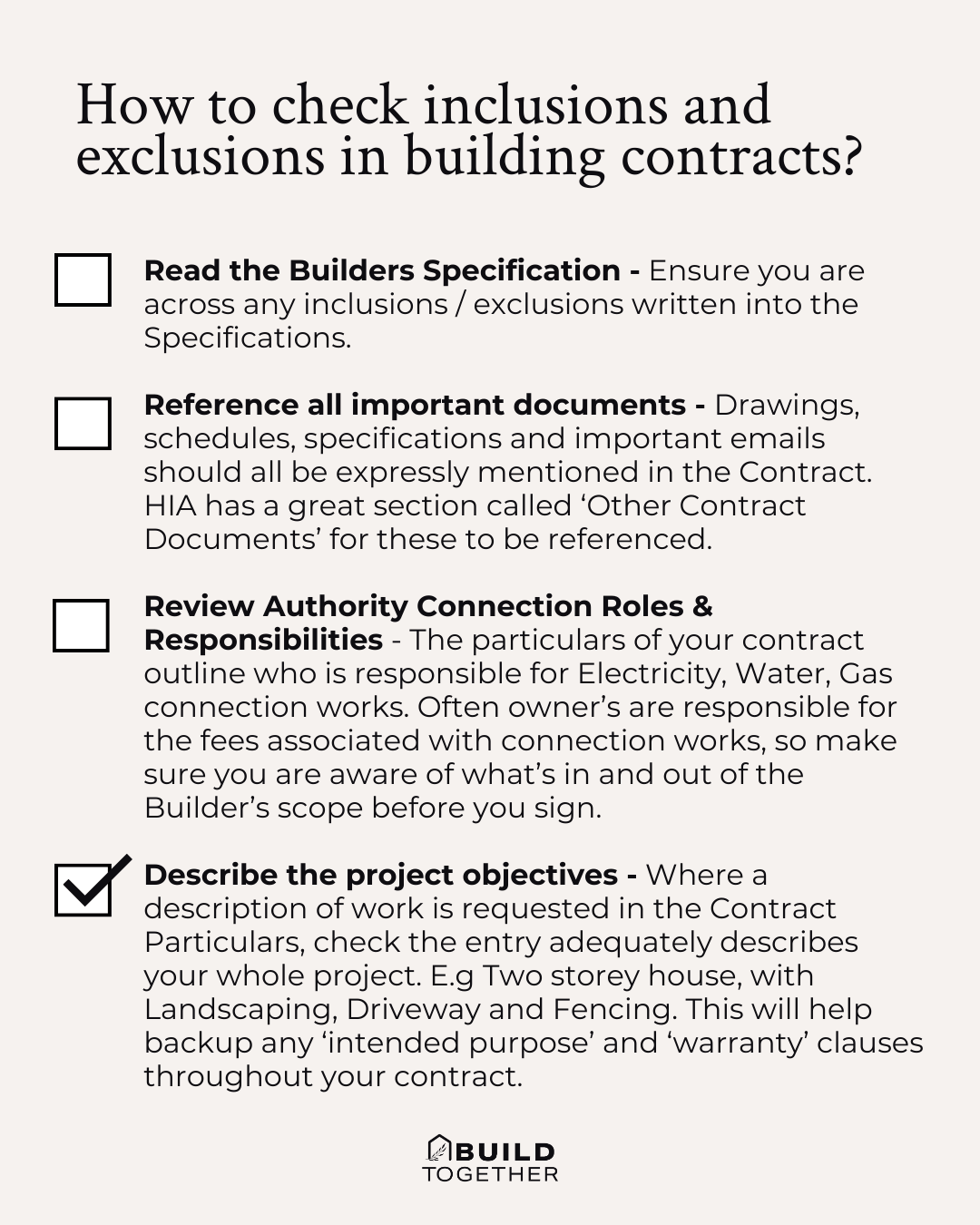
You think a great build comes from a great builder. But actually, it comes from a great contract.
Most people walk into their new build thinking the builder is the most important decision.
But here's what nobody tells you: even the best builder can't protect you from a bad contract.
I've seen it happen over and over. A client gets halfway through their build, excited about their new kitchen, only to discover the flooring they thought was included? Not in the contract. The upgraded fixtures they discussed in that meeting? Never made it into writing. The responsibility for connecting utilities? Somehow that's on them now, not the builder.
And when they go back to sort it out, the contract becomes the single source of truth. Every time.
What most people assume about building contracts
Here's the thing: most people assume that if something was discussed, it's included. If the builder showed it in the plans, it's covered. If it seems like a basic necessity, it must be part of the package.
But that's not how building contracts work.
The reality is, inclusions and exclusions aren't about what makes sense or what was discussed. They're about what's written down, attached, and explicitly referenced in your contract.
I had a client recently who thought reading through the contract once was enough. She trusted the builder, liked the quote, and figured the "standard" HIA contract would cover everything. Three months into the build, she found out the builder's quote had exclusions buried in the fine print that weren't reflected anywhere in her understanding of the scope. It cost her an extra $18,000 to fix.
That's when she called me.
The real reason inclusions and exclusions go wrong
The problem isn't that builders are trying to trick you (most aren't). The problem is that building contracts are designed to be precise, and most people aren't trained to read them that way.
You might think that if something is in the plans, it's automatically included. But unless those plans are expressly attached to the contract and referenced in the right section, they're just pretty pictures.
You might assume the builder's quote covers everything. But if it lists exclusions and you don't cross reference them with the contract, you're signing up for surprise costs later.
You might believe that "industry standard" contracts protect you. But standard doesn't mean safe. The risk isn't the template, it's how the details are filled in.
What actually protects you in a building contract
After working with hundreds of home building contracts, I've learned that the people who avoid nasty surprises during construction do three things differently:
They take every document seriously
The quote isn't just a price list. It's where inclusions and exclusions live. And if it's not attached to your contract, it's not enforceable. Make sure every inclusion and exclusion in the builder's quote is clear, and that the quote is expressly referenced and attached to the contract.
They get everything attached to the contract
Plans, specifications, schedules, geotech reports. If it matters to your build, it needs to be attached to the contract. HIA contracts even have a section called "Other Contract Documents" specifically for this. Use it. If it's not attached, it's not part of the agreement.
They check who's responsible for permits and connections
This one catches people out all the time. Your contract has a section (usually in the particulars) that outlines who is responsible for building permits, utility connections for electricity, water, and gas, and who pays the fees. If you don't check this before you sign, you might be on the hook for thousands of dollars in connection costs you never budgeted for.
Why this matters more than you think
Understanding your contract isn't about being difficult or untrusting. It's about making sure the build you're paying for is the build you actually get.
A quality build doesn't just come from a quality builder. It comes from a quality contract that clearly defines what's in, what's out, and who's responsible for what.
When you know how to check inclusions and exclusions properly, you're not just protecting your budget. You're protecting your timeline, your relationship with your builder, and your peace of mind.
Because the worst time to discover what's not included is when you're standing in your half finished home, wondering why the work has stopped.
What to do next
If you're about to sign a building contract, or you've already signed and you're not 100% confident about what's included, now is the time to get clear.
I offer a Building Contract Health Check where I review your HIA or Master Builders contract and show you exactly:
Where your contract allows for price increases
Which clauses avoid hidden costs and surprise price rises
What's actually included and what's not
How to lock in quality control from the start
You'll walk away with total transparency on build cost and timeframes, and the confidence to move forward without second guessing every decision.
I support clients with their HIA and Master Builders home building contracts from all states in Australia, including Victoria, ACT, Queensland, New South Wales, Tasmania, WA, and the Northern Territory.
Thanks for reading and catch you on my next post :)
Annelyse
Construction Management | M. Construction Law
